San Fruttuoso and the Portofino Park: The Abbey, the Christ of the Abyss, Boats and Trails
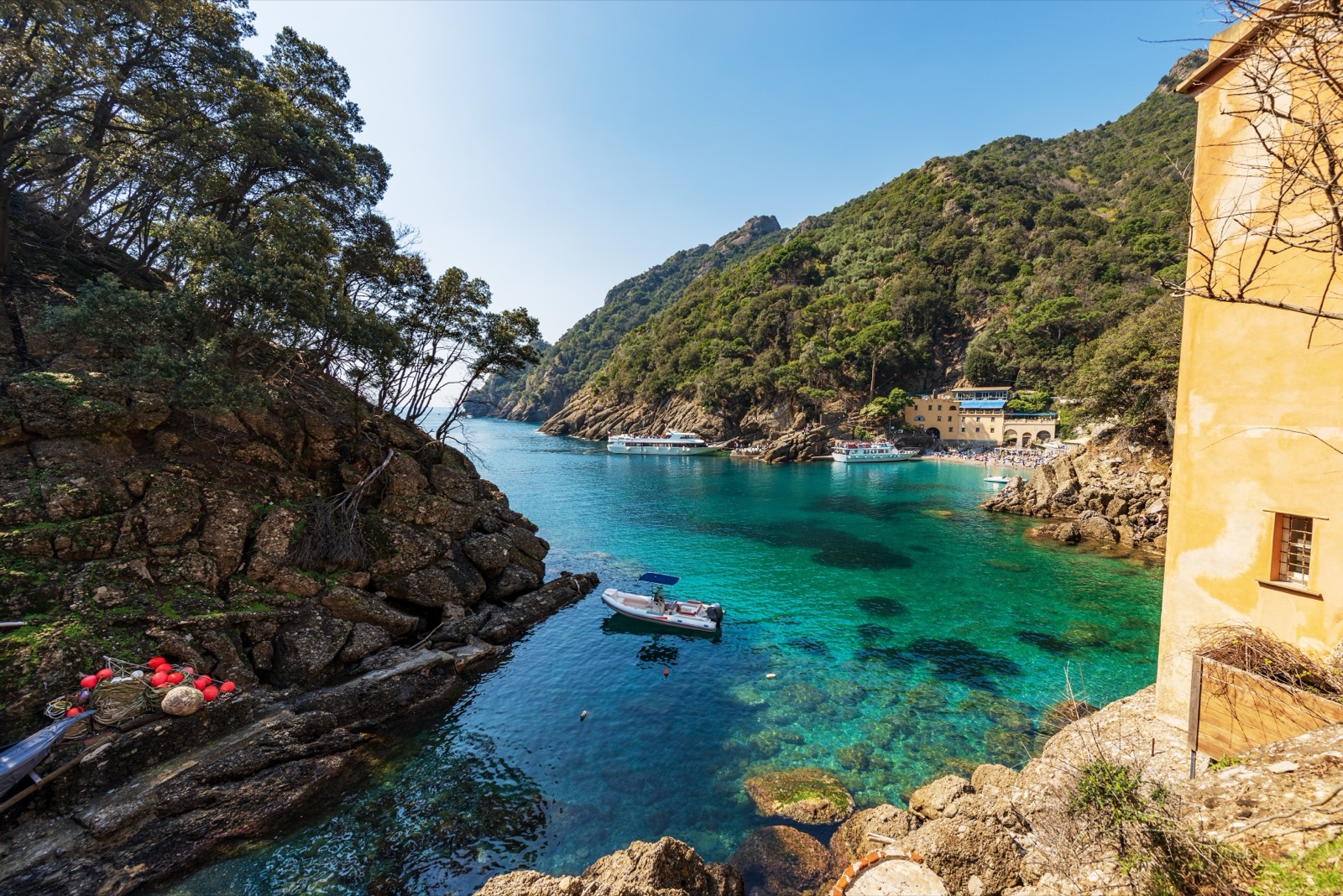
On the far side of the Portofino headland, at the foot of a wooded valley that drops straight into the sea, stands one of the most beautiful places on the Italian coast: the abbey of San Fruttuoso. There is no road. The only ways in are by boat or on foot over the promontory, and that isolation has kept the little cove, with its abbey, its watchtower and its handful of houses, much as it has been for centuries. Offshore, beneath the water of the bay, a bronze Christ stands on the seabed with arms raised towards the surface.
This guide covers San Fruttuoso’s long history, how to visit the abbey, the Christ of the Abyss, how to get there by boat and on foot, and the wider Portofino park and marine protected area that surround it.
San Fruttuoso at a glance
- Set in a small cove guarded by a 16th-century tower, the abbey can be reached only on foot or by sea.
- Its remoteness and a freshwater spring made the cove the site of a church in the 8th century.
- Rebuilt as a Benedictine monastery in the 10th century, it holds more than a thousand years of history.
- The abbey was donated to FAI in 1983 by Frank and Orietta Pogson Doria Pamphilj, and it is now cared for and opened to the public by the Italian heritage trust.
- The bronze Christ of the Abyss was placed in San Fruttuoso bay on 29 August 1954, originally at about 17 m.
A thousand years of history
The founding legend
The story begins with a journey. Tradition says the martyr Fruttuoso himself chose the bay, showing it in a dream to Prospero, bishop of Tarragona, who was fleeing Spain with the saint’s relics. Whatever the truth of the legend, the cove made practical sense: hidden, sheltered and supplied with fresh water, it was a safe place for a church, and its remoteness and a freshwater spring made the cove the site of a church in the 8th century.
The Benedictine abbey
The church grew into a monastery. Rebuilt as a Benedictine monastery in the 10th century, it holds more than a thousand years of history. The abbey became a power on the headland: the village is mentioned in a document of 986 by Adelaide of Italy, which assigned it to the Abbey of San Fruttuoso, so for a time even Portofino belonged to it.
The Doria family
In the Middle Ages the abbey became linked with one of Genoa’s great families. In the 13th century the Doria family moved their burial place here, and 14th-century tombs in white marble and grey stone survive. The funerary hall, with its striped arches and carved inscriptions, is one of the most striking rooms in the abbey.
The tower
The coast was vulnerable to pirate raids, and the cove needed defending. In 1551 Pope Julius III entrusted the complex to Admiral Andrea Doria to build a fortress against pirates; his heirs built the tower in 1562. The square tower still stands guard over the bay and is the landmark you see as the boat comes in. It is a reminder that this peaceful cove was once on a dangerous frontier, where raiders from the sea were a real threat to the monks and fishermen who lived here, and the abbey had to be defended as well as maintained.
From monastery to heritage site
Over time the abbey changed role. Over the centuries the abbey became a residence and, in the 19th century, the parish church of the small fishing hamlet around it. In the 20th century it passed to the heritage trust, and the abbey was donated to FAI in 1983 by Frank and Orietta Pogson Doria Pamphilj. Restored and opened to visitors, it now shows the full sweep of its history, from the medieval church to the Doria tombs.
Visiting the abbey
Tickets
- San Fruttuoso abbey costs €10; reduced €5 for ages 6 to 18 and students up to 25; children up to 5 and FAI members enter free.
- A family ticket (2 adults and children aged 6 to 18) costs €26.
Opening hours
- Last entry is 45 minutes before closing, and hours vary through the year. Check the heritage trust’s website for the times on your date.
- If rough seas stop the boats from Camogli, the abbey stays closed. In unsettled weather, check before you set out.
Christmas Eve
A Mass is celebrated in the abbey church every year on 24 December, one of the most atmospheric occasions on the Ligurian coast.
What you will see
A visit takes you through the church and the rooms of the old monastery, including the Doria funerary hall with its medieval tombs. From the windows and terraces, the view looks out over the cove, the tower and the sea. Allow about an hour, and longer if you want to swim or eat in the cove afterwards.
The Christ of the Abyss
The statue
Beneath the waters of the bay stands San Fruttuoso’s most famous sight. The bronze Christ of the Abyss was placed in San Fruttuoso bay on 29 August 1954, originally at about 17 m. The figure stands with arms raised towards the surface. The statue was the idea of the diver Duilio Marcante after the death of Dario Gonzatti during a dive; the Christ’s arms are open as a sign of peace. The dive to the statue is one of the most famous on the Ligurian coast, and the Christ has become a symbol of the love of diving and the sea.
How it was made
Its bronze came from melted medals, naval parts, including propellers of American submarines, and bells; the sculptor was Guido Galletti.
Where it stands today
The statue has been restored and moved slightly. After restoration it stands on a new base at 14.4 m; the statue is fixed at 12.2 m and its raised hands reach about 10 m below the surface.
Seeing it
- Diving: the dive is relatively easy and shallow, but must be made with guides registered with the Liguria Region, as it lies in the marine protected area.
- Snorkelling and boats: the promontory cruise to San Fruttuoso from Santa Margherita Ligure includes a snorkel stop over the Christ of the Abyss, the simplest way to visit the site without a dive.
Getting there by boat
Most visitors arrive by sea, and the boat ride along the headland is part of the experience.
From Camogli
Boats run to San Fruttuoso from Camogli all year, and seasonally from Recco, Portofino, Santa Margherita Ligure, Rapallo, Sestri Levante, Lavagna, Chiavari and Genoa. Camogli is the reliable year-round gateway, and it is easy to reach by train: from Camogli station to the ferry is 550 m, a 7-minute walk.
From Portofino, Santa Margherita and Rapallo
Line 1 of the Servizio Marittimo del Tigullio links Rapallo, Santa Margherita Ligure, Portofino and San Fruttuoso almost all year, with timetables that vary by season; tickets are sold at the ticket offices. Usefully, a San Fruttuoso ticket bought in Rapallo or Santa Margherita Ligure also allows a stop in Portofino.
Weather
Sailings can be cancelled in bad sea conditions, and because the abbey itself closes when the Camogli boats stop, a rough day can rule out a visit altogether. If the sea looks unsettled, check with the boat company before setting out.
Getting there on foot
The park’s paths
The alternative to the boat is to walk over the headland through the Portofino park. About 80 km of paths cross just over 1,000 hectares of the Portofino park, and the heart of the promontory can be reached only on foot. The abbey can also be reached on foot along the paths of the Portofino park.
Where to start
The park’s main gateways are San Rocco, Portofino Vetta, Nozarego and Portofino, and the main destinations Punta Chiappa, San Fruttuoso and Portofino. The most popular walk links Portofino and San Fruttuoso over the promontory; another approaches from the Camogli side.
What the paths are like
Most paths are old paved or earth tracks that once led to churches, hamlets, olive groves, woods and charcoal kilns. Expect steps, rocky sections and steady climbs and descents through woodland and Mediterranean scrub, with glimpses of the sea. They are not technical, but they need proper shoes, water and a reasonable level of fitness.
Walk one way, sail the other
A classic plan is to walk from Portofino to San Fruttuoso in the morning, visit the abbey and swim, and take the boat back in the afternoon — or the reverse. Check the last boat before you set off on foot. If you miss it, the only way back is the long walk over the headland, which is not something to attempt tired or late in the day.
The Portofino park and marine area
On land
The Portofino regional park was established by Law 1251 of 20 June 1935 and covers 1,055 ha of land in Camogli, Portofino and Santa Margherita Ligure. It protects the whole promontory, from the woods of Portofino Vetta to the cliffs above the sea.
At sea
The Portofino marine protected area was established by ministerial decree on 26 April 1999 and covers the municipalities of Camogli, Portofino and Santa Margherita Ligure. It is the reason diving at the Christ of the Abyss must be done with registered guides, and why the water around the headland is so clear and full of life.
When to go
- All year: boats from Camogli run all year, so San Fruttuoso can be visited in any season when the sea allows. Abbey hours are shorter in the cooler months.
- Summer: the busiest time, with the most boats from the towns of the gulf and from Genoa, and the best swimming in the cove. Arrive early or late to avoid the peak.
- Spring and autumn: the best seasons for walking over the headland, with cooler air and quieter paths.
- Christmas Eve: the abbey’s annual Mass on 24 December.
Whatever the season, the sea decides the day: rough weather stops the boats and closes the abbey.
Diving and snorkelling responsibly
The bay lies within the marine protected area, and its rules exist to keep the water clear and full of life.
- Dive with registered guides, as required for the Christ of the Abyss.
- Look, but do not touch the statue, the seabed or the marine life.
- Keep clear of boat traffic in the bay, and snorkel where your guide or skipper tells you.
- Take all your rubbish away, from the cove as well as the water.
Beyond San Fruttuoso
The headland has more to explore. The park’s main gateways are San Rocco, Portofino Vetta, Nozarego and Portofino, and the main destinations Punta Chiappa, San Fruttuoso and Portofino, so walkers can link San Fruttuoso with Punta Chiappa or Portofino, and boats continue along the coast to Camogli and the Gulf of Tigullio. Portofino itself is covered in our Portofino village guide.
Tours
Promontory cruise to San Fruttuoso. A 1.5-hour boat from Santa Margherita Ligure past Paraggi and the abbey of San Fruttuoso, with a snorkel stop over the Christ of the Abyss. The easiest way to see the bay and the statue.
Easy kayak tour to Portofino. With an instructor and marine guide, paddle from Paraggi to Portofino harbour and on towards the lighthouse, with optional snorkelling in the marine protected area. About 1.5 hours.
Boat from Genoa with free time in Portofino. By boat from Genoa’s Porto Antico, with two hours in Portofino. About 5 hours.
The tours page lists them all with live prices.
Plans for the day
By boat from Camogli
- Morning: train to Camogli and the short walk to the harbour.
- Late morning: boat to San Fruttuoso; visit the abbey.
- Lunch: in the cove, then a swim.
- Afternoon: boat back to Camogli, or on to Portofino in season.
Walking from Portofino
- Morning: start early from Portofino on the path over the headland.
- Midday: arrive at San Fruttuoso, visit the abbey and swim.
- Afternoon: boat back to Portofino or Santa Margherita Ligure.
Portofino and San Fruttuoso by ferry
- Morning: ferry from Santa Margherita Ligure or Rapallo to Portofino; the village, Castello Brown and the lighthouse.
- Afternoon: on to San Fruttuoso on the same ticket; the abbey and a swim.
- Evening: back by boat.
Practical tips
- Check the sea before you go; rough weather cancels boats and closes the abbey.
- Check the last boat back, especially if you arrive on foot.
- Bring water, sun protection and swimwear; the cove is a lovely place to swim.
- Wear walking shoes if you plan to take the paths.
- Buy ferry tickets at the ticket offices, and confirm the return times for the day.
With children
Children usually love the boat ride and the idea of a statue under the sea. Children up to 5 enter free and the family ticket (2 adults and children aged 6 to 18) costs €26. The walking paths are long for young children; the boat is the easier option.
Accessibility
Arriving by boat means crossing a gangway at a small landing, and the abbey has steps and uneven floors. The footpaths over the headland are not suitable for wheelchairs or anyone with limited mobility. Ask the boat company about assistance when you book.
Frequently asked questions
How do I get to San Fruttuoso?
Only by boat or on foot. Boats run from Camogli all year and, in season, from Portofino, Santa Margherita Ligure, Rapallo, Genoa and other towns. Paths cross the Portofino park.
How much is San Fruttuoso abbey?
€10; reduced €5 for ages 6 to 18 and students up to 25; free for children up to 5 and FAI members. A family ticket costs €26.
How deep is the Christ of the Abyss?
Its base is at 14.4 m; the statue is fixed at 12.2 m and its raised hands reach about 10 m below the surface.
Can I see the Christ of the Abyss without diving?
The promontory cruise from Santa Margherita Ligure includes a snorkel stop over the statue. Diving to it must be done with guides registered with the Liguria Region.
Is the abbey open when the sea is rough?
No. If rough seas stop the boats from Camogli, the abbey stays closed.