Places
Camogli: Painted Seafront, Boats to San Fruttuoso and Punta Chiappa
Camogli is a fishing town on the west side of the Portofino promontory, facing the Golfo Paradiso rather than the Gulf of Tigullio. It is best known for the tall, painted houses packed along its seafront, for the Sagra del Pesce each May, when fish is fried in a giant pan by the harbour, and as the year-round port for boats to San Fruttuoso. The Metropolitan City of Genoa’s tourism portal notes its other name: the City of a Thousand White Sailing Ships.
It is not next to Portofino. The two sit on opposite sides of the same headland, with no road between them along the coast. The abbey of San Fruttuoso lies between them and actually belongs to Camogli, and the easiest way to link all three is by boat. This article covers the town, its two big festivals, the boats and their 2026 timetables and fares, the walks from Camogli into the Portofino park, and how to reach Portofino from here.
The short answer
- Where it is: on the west side of the Portofino peninsula, on the Golfo Paradiso, in the Metropolitan City of Genoa.
- What it is known for: the painted seafront, the harbour, the Basilica of Santa Maria Assunta and Castel Dragone on the rocks above it.
- Boats: Golfo Paradiso runs boats from Camogli to Punta Chiappa and San Fruttuoso all year; in 2026 the Camogli–San Fruttuoso fare was €11.00 one way and €17.00 return.
- Festivals: the Sagra del Pesce in May and the Stella Maris on the first Sunday of August.
- To Portofino: by boat, either direct on the seasonal two-gulfs trip or via San Fruttuoso; on foot, stage 10 of the Sentiero Liguria takes 6 h.
Where Camogli is, and how it relates to Portofino
The Portofino promontory is a block of wooded mountain pushed out into the sea east of Genoa. Portofino itself sits in a bay at its southern tip, facing the Tigullio. Camogli sits on the western flank, on the Golfo Paradiso, looking back along the coast towards Genoa. Portofino is often described as the place where one gulf ends and the other begins, marking the geographical border between the Golfo Paradiso and the Tigullio.
Between the two towns is the heart of the promontory, which is protected land. The Portofino regional park was established by Law 1251 of 20 June 1935 and covers 1,055 ha of land in Camogli, Portofino and Santa Margherita Ligure, and the marine protected area covers the sea off the same three comuni. About 80 km of paths cross just over 1,000 hectares of the park, and the heart of the promontory can be reached only on foot.
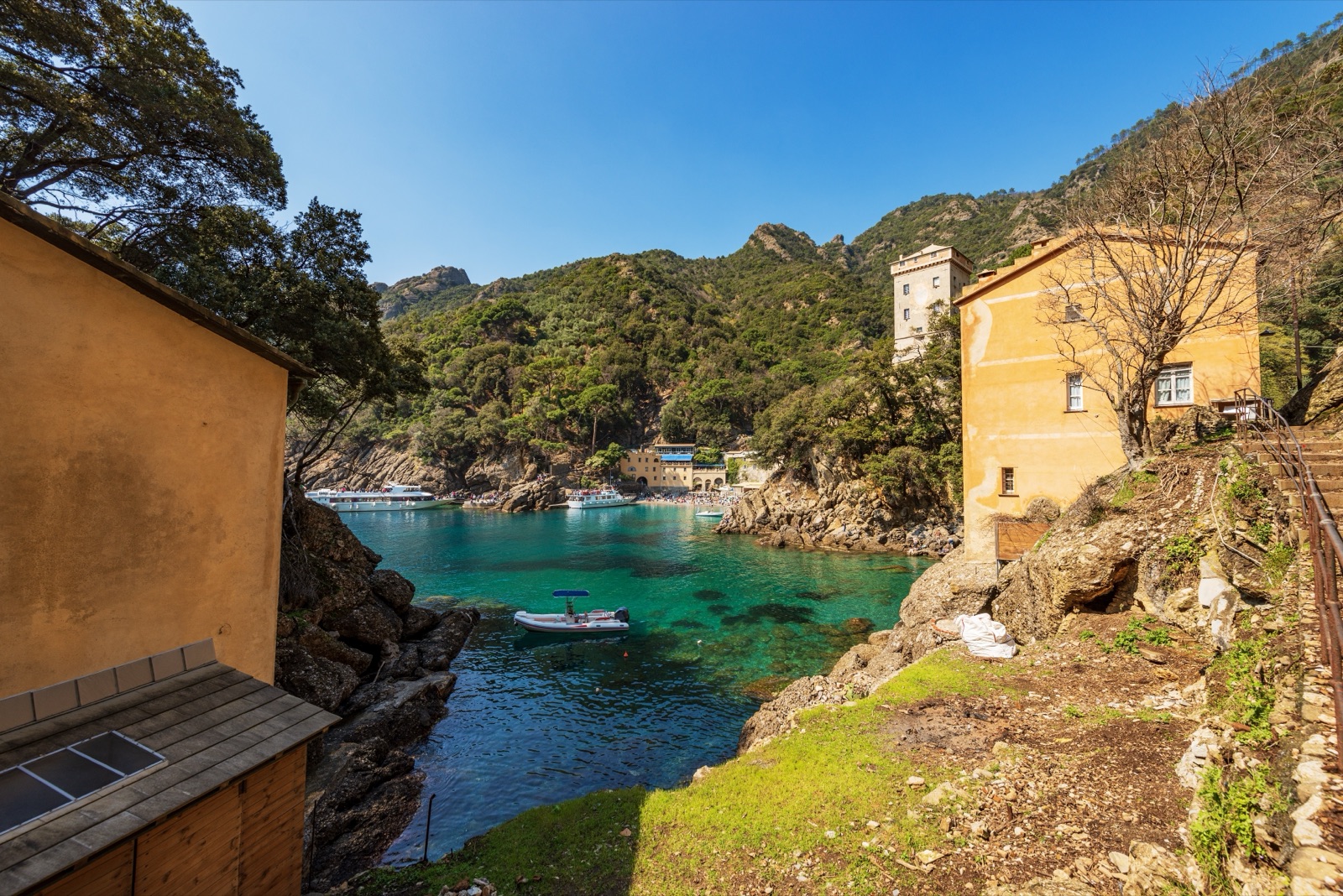
Camogli’s own territory stretches a long way round the headland. Ruta, San Rocco and San Fruttuoso are all hamlets of Camogli. San Fruttuoso, in a small bay on the south of the promontory, can be reached only on foot or by boat, and it is the natural stepping stone between Camogli and Portofino.
In practice, that means:
- Camogli to San Fruttuoso: a short boat ride, all year, or a walk over the promontory.
- Camogli to Portofino: a boat round the headland, seasonal and less frequent, or a long day on foot.
- By train: Camogli has its own station on the coast line, but Portofino has none; the nearest station for Portofino is Santa Margherita Ligure–Portofino, on the other side of the headland.
The seafront and the harbour
Camogli is built steeply. From the centre you reach the sea down narrow stairways squeezed between the tall coloured houses and come out directly above the beach. The seafront promenade runs along the top of the beach, lined with bars, cafés, small restaurants and shops, towards the little harbour.
In the harbour, the fishermen’s small boats are moored beside the tourist ferries, which is a good summary of the town: still a working port, but one that now lives largely on visitors. Above the harbour rise the Basilica of Santa Maria Assunta and Castel Dragone. Below the castle, a partly arcaded lane leads to the pier and the lighthouse, and from there you get the best view back over the famous row of seafront houses, the palazzata that has made Camogli famous.
The town’s maritime past runs deep. The Cristoforo Colombo naval college was founded in Camogli in 1874, and the name City of a Thousand White Sailing Ships remembers the days when its captains sailed the world.
Walk the seafront early in the morning or in the evening light, when the facades glow and the beach is quiet. Then take the lane out to the lighthouse for the classic view.
The basilica on the ‘isola’ and Castel Dragone
Basilica of Santa Maria Assunta
The basilica stands on the rocky promontory at the end of the harbour that locals call the isola, the island, which was once reached by a wooden bridge. The first church there dates back to 1200. Today it has a neoclassical facade and a Baroque interior, reached by a long marble stairway. Inside, look for the inlaid marble floor, the wooden statue of the Assunta and the two large stained-glass windows of the patron saints.
Castel Dragone
Next to it, Castel Dragone rises from a cliff above the sea. It was built against pirate raids; the structure you see today dates from the 1400s. Its rooms are now used as a cultural space for events and temporary exhibitions, so what you can see inside depends on what is on.
The two buildings together make the landmark silhouette you see from the lighthouse and from every boat leaving the harbour.
The Sagra del Pesce in May
Camogli’s best-known festival is the Sagra del Pesce, the fish festival. According to the comune, it was born in 1952 for the feast of San Fortunato, patron saint of fishermen. For decades the fish was fried on small stoves; since 2001 it has been fried in a pan made entirely of stainless steel, which the comune calls the largest in the world.
The 74th edition ran on 8, 9 and 10 May 2026, and the pattern of the weekend is worth knowing if you plan to go:
- The eve: a procession for San Fortunato through the centre, ending with the rincorsa, when the bearers of the saint’s image run up the steps of the Basilica of Santa Maria Assunta. After the fireworks, bonfires built as sculptures by the Porto, Pinetto and Risseu quarters are lit on the beach.
- The Sunday: in 2026, on Sunday 10 May, the frying in the giant pan took place in Piazza Colombo, overlooking the harbour.
- Cost: the comune lists the event as free.
Expect large crowds on the Sunday. Coming by train saves the struggle for parking, and Genova24 reported extra shuttle buses and an extra late train for the 2026 edition. The comune publishes each year’s programme in spring.
The Stella Maris in August
The second great festival belongs to the sea. Camogli celebrates the Stella Maris every year on the first Sunday of August. In the morning, decorated boats leave the harbour in procession for Punta Chiappa, where they meet a procession on foot from the church of San Nicolò. In the evening comes the part most visitors remember: thousands of biodegradable floating lights are handed out, and in the 2026 programme they were set on the sea from 21.15.
Punta Chiappa, the destination of the procession, has a rustic altar to the Stella Maris on its rock. More about getting there below.
Boats to San Fruttuoso and Punta Chiappa
Golfo Paradiso runs the boats from Camogli. Its line calls at Punta Chiappa and San Fruttuoso, and the boats run all year from Camogli; from April to September they also start from Recco, only 5 minutes by boat from Camogli. The operator adds that bottlenose dolphins, striped dolphins and other dolphins are often seen on the crossing.
The 2026 timetable
- June and September 2026: boats left Camogli for Punta Chiappa and San Fruttuoso every hour from 9:00 to 17:00, and the last boat back from San Fruttuoso left at 18:00.
- July and August 2026: the last boat back from San Fruttuoso left at 19:00.
- April, May and October 2026: the last boat back left San Fruttuoso at 17:00. The October timetable runs every day, with the first boat from Camogli at 9:00.
- November and December 2026: boats run every day except Mondays and 25 December 2026, with fewer departures.
Timetables change every year and sometimes during the season, so check the operator’s page before you set out, especially for the last boat back.
Fares (2026)
- Camogli–San Fruttuoso: €11.00 one way, €17.00 return; reduced €7.00 and €11.00.
- Camogli–Punta Chiappa: €7.00 one way, €12.00 return.
- Children: up to 3 travel free with a parent; ages 4 to 12 pay the reduced fare.
Weather and the abbey
Golfo Paradiso sails only in sea and weather conditions its skipper judges favourable. That matters more than usual here, because the abbey depends on these boats: if rough seas stop the boats from Camogli, the abbey stays closed. San Fruttuoso abbey costs €10; reduced €5 for ages 6 to 18 and students up to 25. Our guide to San Fruttuoso and the Portofino park covers the abbey, the Christ of the Abyss and the cove in detail.
By boat from Camogli to Portofino
There is no year-round direct line from Camogli to Portofino, but there are two ways to do it by sea.
- The two-gulfs trip: Golfo Paradiso’s two-gulfs trip runs from Genoa’s Porto Antico via Nervi, Recco, Camogli and San Fruttuoso to Portofino, with the season starting in March 2026. In the afternoon timetable, which ran from March to 24 October 2026, it called at Camogli at 14:50. The stop is 1 h 20 min at Portofino or 2 h at San Fruttuoso. In July and September 2026 it ran every day except Mondays; in spring and autumn it ran only on set dates, so check the calendar. The 2026 fare from Camogli or Recco to Portofino was €13.00 one way and €21.00 return.
- Via San Fruttuoso: take the Golfo Paradiso boat to San Fruttuoso, then the Tigullio company’s Line 1 on to Portofino. The Tigullio 2026 fare table lists Portofino–San Fruttuoso at €12.00 in its one-way column and €20.00 return. The two companies sell separate tickets, so check both timetables before you set out.
By land, the practical route is the train to Santa Margherita Ligure and then bus 782, the ferry or the coastal walk; our guide to getting to Portofino has the details.
Walking the promontory from Camogli
Camogli is the western gateway to the Portofino park. The park’s main gateways are San Rocco, Portofino Vetta, Nozarego and Portofino, and two of them are above Camogli.
Up to San Rocco
San Rocco, 221 m up, is where most walks begin. You can reach it by car or bus from Ruta, or on foot from Camogli railway station along a stepped mule path, a creuza. From the church square the view takes in the Golfo Paradiso from Punta Chiappa to Capo Mele.
San Rocco to Punta Chiappa
The park calls San Rocco–Punta Chiappa one of its classic walks. It leads down the crumbling western side of the promontory, from the farming world of the mountain to the fishermen’s world by the sea, through olive groves and holm oak. On the way you pass San Nicolò di Capodimonte, a Romanesque church whose stone structure was, by tradition, built in the twelfth century. Near the end is Porto Pidocchio, a tiny natural inlet where the boats from Camogli and San Fruttuoso land, so you can walk down and take the boat back.
Over to San Fruttuoso
Two routes lead from San Rocco over the promontory to San Fruttuoso, and the difference matters.
- The Batterie and Passo del Bacio route is closed. The park authority’s page states that the section from the Batterie to San Fruttuoso is currently closed. When open, it is 6 km, takes 3.30–4.15 hours, is graded for expert hikers with equipment and needs a via ferrata kit. Do not attempt it while the closure stands.
- The Pietre Strette route crosses the north-western face of Monte di Portofino through woods and old terraces and comes down to San Fruttuoso by the Doria tower. It is a steady mountain path, not a stroll: wear proper shoes and carry water.
The classic plan is to walk over in the morning, visit the abbey and swim, and take the boat back to Camogli, checking the last boat before you set out.
The long way to Portofino
On the Sentiero Liguria, the long-distance path along the region’s coast, stage 10 runs from Portofino to Camogli on foot and takes 6 h. It is a full day’s hike across the promontory, best done in spring or autumn, with a boat or train back arranged in advance.
Punta Chiappa
Punta Chiappa deserves a visit of its own. The park describes it as a huge monolith of conglomerate reaching into the sea, with a rustic altar to the Stella Maris that is the goal of the August procession. It is a place to sit on the rock, look back at Camogli across the water and watch the boats come and go.
You can reach it by the Golfo Paradiso boat, a short hop from Camogli, or on foot from San Rocco. Many visitors combine the two: walk down, boat back.
Getting to Camogli
- By train: the stop is Camogli station. From Camogli station to the ferry is 550 m, a 7-minute walk, and the start of the walk towards San Fruttuoso is about 300 m from the station.
- By boat: on the two-gulfs trip from Genoa’s Porto Antico, or from Recco from April to September.
- By car: parking is tight in the centre, especially on festival days, so the train is usually easier.
Camogli or Santa Margherita as a base?
Both are good, and they suit different plans.
- Choose Camogli for San Fruttuoso, Punta Chiappa and the walks from San Rocco, all reachable from the harbour or the station. It feels more like a fishing town, and it is the year-round port for San Fruttuoso.
- Choose Santa Margherita if Portofino is the priority: bus 782, the Line 1 ferry and the coastal walk all start there, and the Tigullio boats continue to San Fruttuoso too. See our article on Santa Margherita Ligure.
A day from Camogli
- Morning: coffee on the seafront, then the lane to the lighthouse for the view back over the painted houses.
- Late morning: the boat to San Fruttuoso; visit the abbey and swim in the cove.
- Afternoon: the boat back, stopping at Punta Chiappa on the way.
- Evening: up the stairs to the basilica on the isola at sunset, then dinner by the harbour.
Tours
Promontory cruise to San Fruttuoso. A 1.5-hour boat from Santa Margherita Ligure, on the Portofino side of the headland, past Paraggi and the abbey of San Fruttuoso, with a snorkel stop over the Christ of the Abyss. It suits visitors based in Santa Margherita rather than Camogli.
All Portofino tours and trips. The full listing for Portofino covers boat trips, San Fruttuoso visits and day tours from Genoa and Milan, with live prices. The tours page lists them all.
Frequently asked questions
How do you get from Camogli to San Fruttuoso?
By Golfo Paradiso boat, which runs from Camogli all year, calling at Punta Chiappa. In 2026 the fare was €11.00 one way and €17.00 return. You can also walk from San Rocco by the Pietre Strette path; the Batterie route is currently closed.
Can you get from Camogli to Portofino by boat?
Yes, seasonally. Golfo Paradiso’s two-gulfs trip calls at Camogli and continues to Portofino, with a 2026 fare of €13.00 one way. Otherwise take the boat to San Fruttuoso and the Tigullio Line 1 on to Portofino.
When is the Camogli fish festival?
The Sagra del Pesce is held in May; the 2026 edition ran on 8, 9 and 10 May, with the frying in the giant pan on Sunday 10 May. The comune lists it as free.
Is Camogli near Portofino?
It is on the same promontory but on the opposite, western side, facing the Golfo Paradiso. There is no coast road between them; the links are by boat, on foot through the park, or by train to Santa Margherita and then bus 782.
What is the Stella Maris festival?
A festival held every year on the first Sunday of August. Decorated boats sail in procession to Punta Chiappa in the morning, and in the evening thousands of floating lights are set on the sea.