Places
Santa Margherita Ligure: Villa Durazzo, Paraggi and Boats to Portofino
Santa Margherita Ligure is the town most visitors pass through on the way to Portofino, and for many it is the better place to stay. It sits on the eastern side of the Portofino promontory, at the innermost corner of the Gulf of Tigullio, about 35 km from Genoa. It has what Portofino lacks: the railway station, the start of bus line 782, a proper ferry pier, a long seafront and hotels at more ordinary prices.
It is a separate town, not a suburb of Portofino. The two are linked by a single coast road, the SP227, and by a panoramic walk of about 5 km. Bus, boat and footpath all do the trip, and this article explains each, along with what is worth seeing in Santa Margherita itself: the seafront, Villa Durazzo and its park, the basilica, the little castle and the bay of Paraggi on the road out.
The short answer
- Where it is: on the Riviera di Levante, on the eastern side of the Portofino promontory, about 35 km from Genoa.
- Why stay here: the station (Santa Margherita Ligure–Portofino, on the Genoa–La Spezia line), bus 782 and the Tigullio ferries all start here.
- To Portofino: bus 782 along the SP227, the Line 1 ferry from the seafront pier, or the coastal walk of about 5 km.
- What to see: the seafront and harbour, Villa Durazzo (built in 1678) and its park, the Basilica of Santa Margherita d’Antiochia, the castle of 1550 and the bay of Paraggi.
Where Santa Margherita is, and how it relates to Portofino
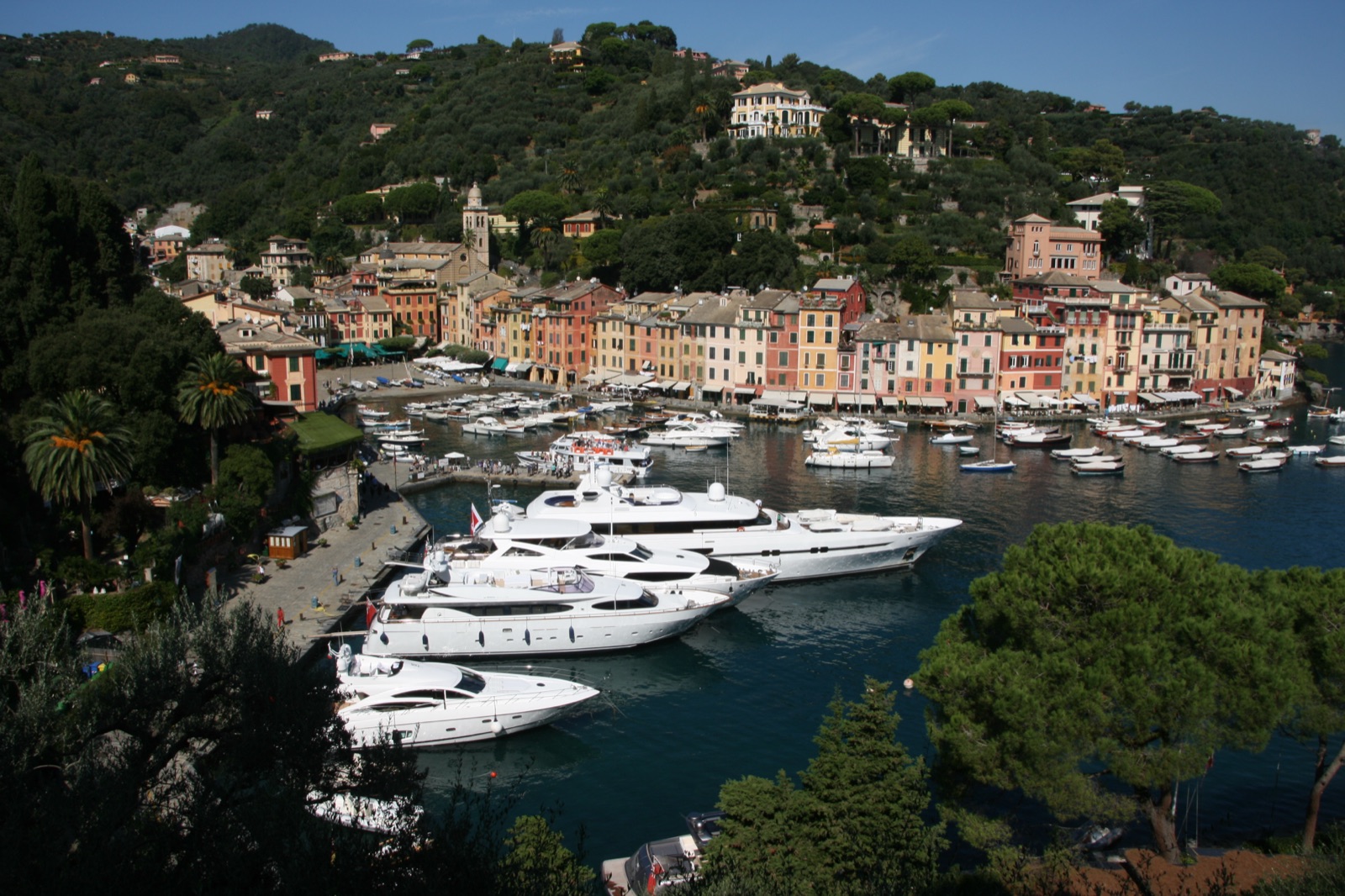
Santa Margherita and Portofino share a headland but face different ways. Portofino hides in its own bay at the tip of the promontory. Santa Margherita spreads around the bottom of the gulf, where the land flattens enough for a town, a harbour and a railway. The Metropolitan City of Genoa describes the hills behind it as dotted with villas and gardens looking over the Costa dei Delfini, the stretch of coast that joins the town to Portofino.
That stretch is where most of the interest lies. Leaving Santa Margherita on road 227 you pass the clifftop former abbey of La Cervara and then reach Paraggi, a small bay that belongs to Santa Margherita, not to Portofino. From Paraggi, Portofino is about 1.5 km further on, and the walk along the seafront to the piazzetta takes about 20 minutes.
The coast here is protected. The Portofino marine protected area was established by ministerial decree on 26 April 1999 and covers the municipalities of Camogli, Portofino and Santa Margherita Ligure, and the regional park on land covers parts of the same three comuni. So when you swim at Paraggi, you are already inside the marine protected area that surrounds Portofino.
The seafront and the harbour
Santa Margherita’s life runs along the water. The ferry operator describes the town’s small harbour, its seafront promenade lined with coloured houses and its traditional Ligurian fishing boats, and that is the scene along the way from the station to the pier.
The town’s own tourism site explains how the beaches work. In the Ghiaia area there are free and private beaches, including Sea for All, a free beach equipped for people with disabilities. From the back of the port a long strip of beach establishments, alternating with free beaches, runs towards the edge of the marine protected area. Beyond that, up to the border with Portofino, lies the Bay of Paraggi, which the same site recommends for snorkelling, freediving and diving.
If you just want a swim, look for the free stretches rather than the beach clubs. The promenade is also where the ferries to Portofino, San Fruttuoso and the Cinque Terre leave, from the pier in the seafront gardens.
Villa Durazzo and its park
Villa Durazzo is the main sight in the town itself, on the hill above the harbour.
The villa
The villa was built in 1678 as the summer residence of the Durazzo family. The Centurione princes owned it in the nineteenth century, and since 1973 it has belonged to the Municipality of Santa Margherita Ligure. Its most famous guest arrived in between: Queen Margherita of Savoy stayed here in 1904, when the building was used as a Grand Hotel.
Inside, the apartments of the noble floor are open to visitors and house a gallery of the Genoese school of painting from the sixteenth, seventeenth and eighteenth centuries, with frescoes, stucco ceilings and period furniture. The villa also holds a reconstruction of the study of Vittorio G. Rossi, a writer and journalist born in Santa Margherita in 1898, with his books, prizes and souvenirs of his travels.
The park
For most visitors the park is the reason to climb the hill. It covers about three hectares overlooking the Tigullio Gulf. Its oldest part is the citrus grove created by the Durazzo family on a terrace facing the sea; the Italian garden, with clipped hedges, dates from the nineteenth century. Below it, a Romantic English-style wood leads down on cobbled paths past fountains and statues to the square in front of the villa. From the terraces the view opens over the harbour and the gulf.
Hours and tickets
- Hours: the villa’s own site gives the villa as open daily 9:30–13:00 and 14:00–18:00, and the park as open 9:00–19:00. These were the hours shown in late September 2026; they change for events, so check before you go.
- Tickets: the Grandi Giardini Italiani listing for the 2026 season gives the park as free to enter and the villa at €6.00 full, €4.00 reduced and €3.00 for children.
Allow an hour for the park and another for the rooms. The villa is a short walk uphill from the seafront, and it pairs well with the castle at the foot of the same hill.
The basilica and the castle
Basilica of Santa Margherita d’Antiochia
In the historic centre stands the Basilica of Santa Margherita d’Antiochia, also called the Sanctuary of Our Lady of the Rose. It dates from the mid-1600s, when the first stone was laid on the site of a thirteenth-century place of worship. It is unusually wide, framed by two bell towers, with a Latin-cross plan and three domed naves.
The second name comes from a local devotion. Every year, on the Sunday before Ascension, the feast of Our Lady of the Rose is celebrated and the roses brought by residents are blessed. If you are in town that weekend, it is worth seeing.
The castle
Santa Margherita’s castle was built in 1550 on a decision of the Senate of the Republic of Genoa, to defend the town from frequent pirate raids. It stands at the foot of the hill below Villa Durazzo and was originally right by the sea.
Getting from Santa Margherita to Portofino
There are four ways to do the last stretch. Our guide to getting to Portofino compares them in detail; here is what matters if you start in Santa Margherita.
By bus 782
Line 782 is run by AMT, Genoa’s transport company, from Santa Margherita station along the SP227 to Portofino. It calls at Piazza Vittorio Veneto in the centre and at Paraggi on the way.
- Ticket: AMT’s single ticket for line 782 costs €5.00 and is valid for one ride. Validate it when you board and keep it for the whole journey.
- Where to buy: at AMT ticket offices, through the AMT app, at approved resellers such as newsagents and tobacconists, and from AMT ticket machines.
- Frequency: AMT’s summer timetable ran from 15 June to 13 September 2026, with buses leaving the station every 15 minutes through the day.
- Journey time: in that timetable the first bus of the day took under 20 minutes from the station to Portofino. Traffic on the narrow road can make it slower in high season.
Outside the summer timetable the service runs to a different pattern, so check the current timetable on AMT’s site before relying on a late bus back.
By ferry
The Tigullio ferries leave from the boat pier in the gardens of Piazza Martiri della Libertà on the seafront, about 700 m from the railway station, a 5–10 minute walk. Line 1 of the Servizio Marittimo del Tigullio links Rapallo, Santa Margherita Ligure, Portofino and San Fruttuoso almost all year, with timetables that vary by season, and tickets are sold at the ticket offices on the pier.
- Fares: the operator’s 2026 fare table lists Santa Margherita–Portofino at €12.00 in its one-way column and €20.00 return, and Santa Margherita–Portofino–San Fruttuoso at €16.00 and €24.00.
- Two stops, one ticket: a San Fruttuoso ticket bought in Rapallo or Santa Margherita Ligure also allows a stop in Portofino.
- Quiet days: departures need at least 20 passengers per boarding point, so out of season some sailings may not run.
- Evenings: in July and August evening boats run from Rapallo and Santa Margherita Ligure to Portofino and back.
- Weather: sailings can be cancelled in bad sea conditions. Ask at the pier for the day’s return times when you buy your ticket.
The ride is short, and arriving by sea is the classic way to see Portofino: the harbour opens up in front of you as the boat rounds the point.
On foot
The panoramic walk from Santa Margherita Ligure to Portofino is about 5 km. It follows the coast past the Cervara, Paraggi and a string of small coves, and it is easy walking with views across the gulf. For much of the way it runs close to the SP227, so it is most pleasant early in the day, before the traffic builds.
For a quieter route, the Portofino park describes an inland path. It starts from the Corte quarter of Santa Margherita and climbs to Nozarego, then continues through woods to the Mulino del Gassetta, a park information point with an equipped picnic area, and past the little church of San Sebastiano into Portofino. It is a proper footpath with climbs, so wear walking shoes and carry water.
A good plan is to walk one way and take the bus or ferry back.
By car
The road is the SP227, and it is the only road into Portofino. Portofino’s historic centre is a limited-traffic zone, and cars must use the covered car park at the bottom of the access road, which costs about €8 an hour. For most visitors it makes more sense to leave the car in Santa Margherita and take the bus or ferry.
The road is also exposed to the sea. The SP227 between Santa Margherita and Portofino was devastated by the sea storm of 29 October 2018: the collapsed stretch was 120 metres long, and rebuilding it took just under 160 days. It reopened in April 2019. In autumn storms, the road and the ferries can both be disrupted.
Paraggi: the bay on the way
Leaving Santa Margherita on road 227 towards Portofino you reach Paraggi, a hamlet of Santa Margherita. The Metropolitan City of Genoa describes a tiny inlet with very clear water, holding the Castello di Paraggi, a nineteenth-century adaptation of a Genoese fortress, a small, exclusive sandy beach, restaurants and nightspots. Its seabed is popular with divers because it suits the growth of red coral.
Three things to know before you go:
- Space is tight. The sandy beach is small. It is a public beach, but it also has private beach clubs, so arrive early in summer if you want a free spot.
- It is on the bus route. Line 782 stops at Paraggi, so you can combine a swim with the bus on to Portofino.
- It is the start of the kayak tour. An easy guided kayak tour paddles from Paraggi to Portofino harbour and on towards the lighthouse, with an instructor and marine guide and optional snorkelling, in about 1.5 hours.
For the other swimming spots nearer the village, Baia Cannone and Niasca, see our Portofino village guide.
La Cervara
Between the town and Paraggi, the former abbey of San Girolamo della Cervara stands on a cliff above the sea beside the road. In 1546 Pope Paul III raised the priory to an abbey. It was bought by its present owners in 1990 and restored, and today it is used for cultural and private events, so treat it as a sight to admire from the road and the path rather than a place to drop in. The park’s inland path gives a fine view down onto it.
Getting to Santa Margherita
- By train from Genoa: trains run from Genoa Principe and Brignole to Santa Margherita Ligure almost every hour.
- By train from Milan: direct Intercity or regional trains reach Santa Margherita Ligure–Portofino in about 2 hours.
- If your train does not stop here: if your train does not stop at Santa Margherita Ligure, the next station is Rapallo, which also has buses and ferries to Portofino.
- By ferry from Rapallo: the same 2026 fare table lists Rapallo–Santa Margherita Ligure at €6.00 one way and €9.00 return.
From the station it is a 5–10 minute walk to the ferry pier on the seafront, and bus 782 leaves from the station itself.
Beyond Portofino: boats from the pier
Santa Margherita’s pier serves more than Portofino.
- San Fruttuoso: Line 1 continues round the headland to the abbey of San Fruttuoso, reachable only on foot or by sea. See our guide to San Fruttuoso and the Portofino park.
- The Cinque Terre: from Santa Margherita Ligure, the same boat company also runs excursions to the Cinque Terre (lines 4 and 5).
Santa Margherita or Portofino: where to stay?
Staying in Portofino itself is a splurge: in season, a hotel room in Portofino starts at around €700 a night, and a fish dinner costs at least €100 a person. Santa Margherita has far more rooms, restaurants and shops, and it is the transport hub for the whole promontory.
The trade-off is atmosphere. Portofino in the evening, after the day visitors leave, is a different place from Portofino at noon. From Santa Margherita you can still have that evening: in July and August the evening boats run to Portofino and back, and the bus runs late in summer.
Santa Margherita also has its own history as a resort. The town’s tourism site dates its golden age to the arrival of the road to Portofino and the railway, which brought the villas and grand hotels that still line the Costa dei Delfini.
A day from Santa Margherita
- Morning: walk to Portofino along the coast, stopping at Paraggi for a swim.
- Late morning: coffee in the piazzetta, then the climb to Castello Brown, where a ticket for the castle and its park costs €10.00.
- Afternoon: take the Line 1 ferry on to San Fruttuoso, on the same ticket if you bought it in Santa Margherita, then back.
- Evening: Villa Durazzo’s park before closing, and dinner on the seafront.
Tours that start here
Several boat trips use Santa Margherita as their base or pass right by it.
Promontory cruise to San Fruttuoso. A 1.5-hour boat from Santa Margherita Ligure past Paraggi and the abbey of San Fruttuoso, with a snorkel stop over the Christ of the Abyss.
Coastal cruise from Rapallo with a Portofino stop. A boat with a shaded sundeck from Rapallo past Santa Margherita Ligure and the cliffs, stopping in Portofino. About 4 hours; the best fit if you are staying in Rapallo or Santa Margherita.
The tours page lists them all with live prices.
Frequently asked questions
How far is Santa Margherita Ligure from Portofino?
The panoramic walk between them is about 5 km, following the coast beside the SP227 for much of the way. Bus 782 does the trip in under 20 minutes on the summer timetable, and the Line 1 ferry takes you round by sea from the seafront pier.
How much is the bus from Santa Margherita to Portofino?
AMT’s single ticket for line 782 costs €5.00 for one ride. Buy it before boarding at an AMT office, a reseller or a ticket machine, or through the AMT app, and validate it on the bus.
Where does the ferry leave from in Santa Margherita?
From the boat pier in the gardens of Piazza Martiri della Libertà on the seafront, about 700 m from the railway station. The operator’s 2026 fare to Portofino is €20.00 return.
Is Paraggi part of Portofino?
No. Paraggi is a hamlet of Santa Margherita Ligure on the road to Portofino, about 1.5 km before the village. Bus 782 stops there, and it has a small sandy beach and very clear water.
Is Santa Margherita Ligure worth staying in?
For most visitors, yes. It has the station, the bus and the ferries, far more hotels than Portofino, and its own sights in Villa Durazzo, the basilica and the seafront. Portofino is a short bus ride, boat trip or walk away.